I have something of a grasshopper mentality when it comes to inspiration for my characters and their stories. If you prefer to read sagas in chronological order, here’s a handy list. Links to all my books are in the Amazon widget to the right.
1065—Conquering Passion—Montbryce Legacy I
1066—If Love Dares Enough—Montbryce Legacy III
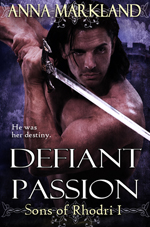
1066—Defiant Passion—Sons of Rhodri I *
1087—A Man of Value—Montbryce Legacy II
1100—Passion in the Blood—Montbryce Legacy IV
1106—Dark and Bright—Sons of Rhodri II
1107—The Winds of the Heavens—Sons of Rhodri III
1107—Dance of Love (Dec 2012)—Montbryce-The Next Generation III
1113—Carried Away—FitzRam Family I
1120—Sweet Taste of Love—FitzRam Family II
1124—Wild Viking Princess—FitzRam Family III
*The complete Sons of Rhodri Trilogy is available in paperback from Amazon.
If you like stories with medieval breeds of dogs, you’ll enjoy If Love Dares Enough, Carried Away, and Wild Viking Princess. If you have a soft spot for cats, read Passion in the Blood.
If you are looking for historical fiction centred on a certain geographic region:
English History—all books
Norman French History—all books
Crusades—A Man of Value
Welsh History—Conquering Passion, Defiant Passion, Dark and Bright, The Winds of the Heavens
Scottish History—Conquering Passion, A Man of Value, Sweet Taste of Love
European History (Holy Roman Empire)—Carried Away
Danish History—Wild Viking Princess
Spanish History—Dance of Love (Dec. 2012)
If you like to read about historical characters:
William the Conqueror—Conquering Passion, If Love Dares Enough, Defiant Passion
William Rufus—A Man of Value
Robert Curthose, Duke of Normandy—Passion in the Blood
Henry I of England—Passion in the Blood, Sweet Taste of Love
Heinrich V, Holy Roman Emperor—Carried Away
Vikings—Wild Viking Princess
Kings of Aragon (Spain)—Dance of Love (Dec. 2012)
Wednesday, 3 October 2012
Tuesday, 18 September 2012
The Big Reveal
I am delighted to announce the unveiling of new covers
for my third medieval romance series, The FitzRam Family.
The completion of this project signifies a milestone for me.
All ten of my published books now have professionally designed covers.For this
series I worked with Steven Novak, (http://www.novakillustration.com/bookcovers.html)
who also did the covers for Mimi Barbour’s new releases, Partners and Roll
the Dice. Like Mimi, I can heartily recommend him.
The process of working with a designer to produce covers can
be a trying one. Sometimes it’s hard to achieve a meeting of the minds. Steven
was open to all my ideas and willing to make lots of changes. He wanted me to
be comfortable with the finished product, and I am!
Special thanks to fellow authors Mimi Barbour, Helen Scott Taylor (Oceans Between Us) and Lois Lavrisa (Liquid Lies) for permission to use quotes from their reviews.
So without further ado, here are the covers.
Sunday, 16 September 2012
A Brief History of Schleswig-Holstein
![]() |
| Map of Denmark 1570 |
The setting for my latest release, Wild Viking Princess is the island of Strand, which in medieval times was located off the west coast of Denmark. As I described in a previous post, the island was torn apart by a vicious storm in 1634, and became three islands.
The history of the region is a long and complex one. Those lands now belong to Germany. Below is an attempt to simplify that history by means of a timeline.
450 - 500 Angles, Saxons (the
Anglo-Saxons) and Danes from the area that would much later be known as
Schleswig-Holstein raided England after the Romans had left. They found the
fertile land good for farming, and settled, bringing their families over
798 Charlemagne defeated the
north-Elbian Saxons, supported by his Slavonic allies who had settled in
eastern Holstein 400 years before.
804 Charlemagne began to have
fortified settlements built north of the Elbe-River, beginning with Hamburg -
which was never part of Schleswig-Holstein. He drove several thousand Saxon
families out of their homeland, and made them settle in southern Germany
(Bavaria, Suabia, Rhine-area).
from 804 Beginning of
Christianisation of the pagan North, churches were built.
900 Haithabu, a thriving town
that would later be rebuilt as Heddeby, was a trading-post of European
importance. The population was mainly Danes and Vikings from Sweden.
800- 1100 The land north of the
Elbe-River and Hamburg was raided and dominated by Danes. The Franks, whose
dominance in Germany was taken over by Saxon rulers, tried to keep up their
influence. My latest release, Wild Viking Princess, is set in 1124 AD.
![]() |
| Reconstructed Viking village |
1111 Adolf I. of Schauenburg was
installed as Count of Holstein. He and his heirs brought peace and Christianity
back to Holstein. Many towns and churches were founded and built during the
rule of the Schauenburgers. Dutchmen, Frisians and Westfalians were called into
his county, of whom especially the Dutchmen and the Frisians were experts in dyking,
and in turning marshes and moors into fertile land and safe ground. They came
as colonists, stayed and settled, mixing with the native population. The
Slavonic people in eastern Holstein were gradually integrated into Holstein, with
the help of the Bible, patient colonisation, and mainly the sword. Schleswig remained
under Danish rule, with a mixed population of Danes and Germans.
1200 - 1203 Holstein, Hamburg,
Luebeck and Ratzeburg fell into the hands of the expansive Danish Kings, Knud
(- 1202) and Waldemar II., who ruled from 1202 to 1241.
1227 Battle of Bornhoeved. A
decisive battle amongst several that had been fought before. Holstein was
reconquered, and the Danish policies of expansion were ended.
1227 - 1460 This period may be called
"struggle for dominance in Schleswig", Danes and Germans claiming and
negotiating their rights.
abt. 1350 The "Black
Death", the bubonic plague, haunted Denmark and the duchies. Especially
the west coast and the islands were afflicted. Of an estimated population of
420 000 souls in both duchies in 1340, there were only 230 000 left in 1353.
1440 Holstein and Schleswig
united under Adolf VIII. of Schauenburg, the last of his line.
1460 Treaty of Ripen: the Danish
King Christian I. was installed as Duke of Schleswig and Count of Holstein. He
had to grant privileges to the knighthood of the two lands and to their people.
Apart from that and before all, he vowed that Schleswig and Holstein would
remain forever undivided.
1474 Holstein became a duchy.
1500 The Battle of Hemmingstedt.
The Duke of Holstein, King Hans of Denmark, attempted once again (after his
predecessors had failed in 1319 and in 1404) to bring the renitent Dithmarscher
population under his yoke, to make them pay their dues. He had hired 4000
fierce mercenaries, the Black Guard, who were followed by 2000 knights of all
noble houses of Schleswig, Holstein and Denmark, and another 5000 armed
subjects. The Dithmarschers, highly outnumbered, battled for their independence
once more, and did so successfully, for the last time.
1569 Dithmarschen's last feud.
The King of Denmark came with an army of 18 000 well armed followers and took
the country. The Dithmarschers had to acknowledge his reign, and to give up
their old parliamentary system of self-administration.
1618 - 1648 The Thirty Years' War
brought devastation over Schleswig, Holstein and vast parts of Europe. The
German Emperor sought to reinstall the Catholic Belief in all of Germany, after
Protestantism according to Martin Luther's doctrines had spread over most parts
of northern Germany during the bygone century. What had started off as a
religiously motivated crusade turned into a European war, with shifts of power
and territorial changes in the end. Schleswig and Holstein were afflicted by heavy
looting, and also by diseases the passing troops were the carriers of,
especially the bubonic plague once again. Those who survived fled from their
farms. It took a long time until Schleswig and Holstein had recovered from that
cruel war.
![]() |
| 16th century map of Denmark |
1634 The North Sea coast and
islands were destroyed by a tremendous flood that tore apart everything that
hard-working Frisians and Dithmarschers had built to protect their land from
the sea's destructive force. The large island Nordstrand was washed into the
sea, leaving only two small fractions to exist after the deluge. Of the 8 600
inhabitants, only a quarter survived.
1700 - 1721 The Nordic War
between Sweden on one side and Denmark, Poland and Russia on the other, saw
Schleswig and Holstein as a battlefield again. Marauding troops devastated
large parts of the duchies.
1760 - 1800 Peaceful times, for a
change. Reformation of the archaic structures in farming: fields that had been
used by all villagers were split up into individual property, and the whole
territory belonging to a village was restructured, into larger units and with
new roads. Moors and bogs were colonized by settlers from southern Germany, who
also introduced the potatoe as a staple food into Schleswig-Holstein, where
people had been used to live of buckwheat, oats, and cabbage mainly.
1800 - 1805 Serfdom was abolished
in both duchies. One of the points of conflict in my novel is the Danish tradition of thralldom, or slavery.
1813 King Friedrich (Frederic)
VI. of Denmark had opted to join arms with Napoleon, the expansive-minded
French ruler. The war had brought the economy to the ground, and the Kingdom
was bankrupt. Whose riches were counted in bankdrafts or cash money, he became
a poor man in 1813. And Prussian, Swedish, and Russian troops invaded
Schleswig-Holstein, bringing destruction over the duchies. The Russians did not
leave until December 1814.
1814/15 The Duchy Lauenburg came
under Danish rule (the Danish King became Duke of Lauenburg).
1815 The "German
League" (der Deutsche Bund) was established, Holstein part of it, but
remaining under Danish rule (the King of Denmark was the Duke of Holstein. He
represented Holstein in the German National Assemblies. He was also the Duke of
Schleswig, but Schleswig was not part of the "German League").
1815 - 1848 Nationalistic and
patriotic activities on both sides of the Eider-River, mainly about the status
of Schleswig, which was the focus of interest of Germans and Danes likewise.
1848 The Danish King granted the
Duchy Holstein the right of a constitution of its own, and, under strong
patriotic and nationalist influence, decided that the Duchy Schleswig should
have a constitution that was valid for the whole Danish Kingdom, with Schleswig
part of it. That would have eased the long-standing union of the two duchies
apart, by way of political and administrative means. The duchies installed a provisional
government of Schleswig-Holstein in Kiel, under the German flag and under the
colors of hope for a united German Schleswig-Holstein: the new flag in blue,
white, and red.
1848 - 1851 Uprise and war
against Denmark. Schleswig-Holsteiners fought along with many volunteers of all
Germany, and a very strong Prussian contingent. Denmark came out victorious at
the end. Many casualties on both sides.
1852 - 1864 Denmark forced the
Danish language upon large parts of Schleswig, to be spoken in schools, at
court, and in church (in turns with services in German). Dismissal of pro-German
officers from the army, of pastors and teachers, of functionaries in public
office. Many Schleswig-Holsteiners opted for emigration under those oppressive
circumstances, hoping to find in America or Australia what they could not find
here.
1864 Denmark imposed the
all-Danish constitution upon the Duchy Schleswig. Conflicting views about the
rightful succession for the office of the Duke of Schleswig. Prussian and
Austrian troops fought the war with the duchies, driving the Danish army out of
Schleswig-Holstein. With the Treaty of Peace of Vienna, the Danish Kingdom
renounced all claims and rights in the duchies Schleswig, Holstein, and
Lauenburg. The people of Schleswig were given the option of choosing Danish
citizenship within the following six years. Many made use of that offer to
avoid military service under Prussian conditions. They became Danish subjects
living in Prussia, without political rights.
1864 - 1866 Holstein under
Austrian administration, Schleswig and Lauenburg under Prussian.
1866 Prussian - Austrian War
about dominance in the German League. Austria defeated. All three duchies under
Prussian administration. Universal conscription was introduced, a three years
term of service became compulsory for everyone.
1867 Schleswig-Holstein-Lauenburg
(the latter officially in 1876) were integrated into the Kingdom Prussia. The
duchies were ruled from Berlin. The Schleswig-Holsteiners became
"Must-be-Prussians". The dream of a state of their own was over. A
rise in the number of emigrations ensued.
1870 - 1871 Germany (Prussia,
rather) at war with France.
1871 Establishment, foundation of
the "German Reich" (das Deutsche Reich). The duchies, now called
"Regierungsbezirk Schleswig", as a Prussian province, being part of
it.
1914 - 1918 World War One,
Germany defeated. Denmark remained neutral.
1919 Treaty of Peace of
Versailles. It was decided that the northern German border in Schleswig should
be redrawn, taking into account the will of the people, to be expressed in a
referendum, with the choice of Danish or German citizenship.
![]() |
| Denmark today |
1920 The new border between
Germany and Denmark was drawn as it still exists today. There remained,
however, Danish minorities living this side of the line, as well as German
minorities in Denmark, each with the privilege of the use of their language and
the cultivation of their national heritage.
Saturday, 15 September 2012
The Norse Gods
The Norse Gods are mythological characters that, as far as we know, came from the Northern Germanic tribes of the 9th century AD. These stories were passed down in the form of poetry until the 11th – 18th centuries when the Eddas and other medieval texts were written. Norse mythology comprises the pre-Christian beliefs and legends of the Scandinavian peoples including those who settled on Iceland where most of the written sources for Norse mythology were assembled. Norse mythology not only has its gods, goddesses and immortals but also a myriad of other characters and creatures that populate the stories including giants, dwarfs, monsters, magical animals and objects.
In my book, Wild Viking Princess, I have referred to several Norse gods. Though my story takes place well into the Christian era (1124AD), many Scandinavians continued to hold a curious mixture of pagan and Christian beliefs.
![]() |
| Freyja |
My heroine, Ragna, has a dog called Thor, named after the God of Sky, thunder and fertility. He is associated with law and order in Asgard and guardian of the Norse gods. He is the son of Odin and Earth and husband of Sif. He is also known as the “thunder god” and “charioteer”. Among many tribes Thor actually supplanted Odin as the favorite god. He is considered to be the protector of all Midgard, (the realm of mankind) and he wields the mighty hammer Mjollnir. Thor is strength personified. His battle chariot is drawn by two goats, and his hammer Mjollnir causes the lightning that flashes across the sky. Of all the deities, Thor is the most “barbarian”; rugged, powerful, and lives by his own rules, although he is faithful to the rest of the Aesir gods. The day Thursday (Thorsdaeg) is sacred to him.
![]() |
| Thor |
Thor was the god of war, thunder and strength. He destroyed the enemies of the gods with his magic hammer. It was he who chased away the frosts and called gentle winds and warm spring rains to release the earth from its bondage of ice and snow. He was also the god of the household and of the common people. He even married Sif, a peasant woman. The lightning’s flash was his mighty hammer, Mjollnir, hurled in battle with the frost giants, and the rolling thunder was the rumble of his fiery chariot.
Thor was a good-natured, careless god, always ready for adventure, and never tired of trying his great strength. He could shoulder giant tasks with the greatest ease and slay bulls with his bare hands. For sport he sometimes rode among the cloud-veiled mountains, hurling his hammer at their peaks and cleaving them in two.
Thor is usually portrayed as a large, powerful man with a red beard and eyes of lightning. Despite his ferocious appearance, he surpassed his father Odin in popularity because, contrary to Odin, he did not require human sacrifices. In his temple at Uppsala he was shown standing with Odin at his right side. This temple was replaced by a Christian church in 1080.
Other deities making an appearance in the book include Vàr - the goddess of oaths, and Màni, the god of the moon. Wild Viking Princess is available from Amazon for $1.99.
Wednesday, 12 September 2012
An Island Swept Away
In the Middle Ages the island of Strand, off Denmark's west coast, encompassed approximately 210 square miles. I used this island as the setting for my latest release, Wild Viking Princess.
A disastrous storm tide in the year 1634 tore the island apart, long after my hero (Reider) and heroine (Ragna) lived there in 1124 AD.
![]() |
| I visualized my hero striding along this beach |
6000 people drowned in the disaster, and one island became three, Nordstrand, Pellworm and Hallegin.
Nordstrand today is a peninsula, linked to the mainland by the Beltringerharder, a polder of land reclaimed from the sea.
![]() |
| Pellworm Lighthouse |
![]() |
| Pellworm today |
![]() |
| Nordstrand beach today |
All three islands now belong to Germany, but my hero, Reider Torfinnsen, is Danish. In fact he is the Prince of Strand. The history of this part of Europe, known as Schleswig Holstein, is complex. I will attempt to clarify it in a future article.
Nordstrand is the origin of a locally famous alcoholic beverage, the Pharisäer ("Pharisee"), which the islanders developed in 1872 to be able to drink alcohol in the presence of local pastor Georg Bleyer, who preached abstinence. It is made from strong hot coffee, sugar, dark rum and whipped cream (to prevent the alcohol from evaporating, so that it could not be smelled). The pastor usually got the only cup without rum, but one day the cups got mixed up. When he discovered the deceit he exclaimed "Ihr Pharisäer!" ("You Pharisees!"). Hence the name.
Monday, 10 September 2012
A Dog Steals the Limelight Again!
I’ve done it again! Made a dog the star of my
latest book! This time it’s a medieval breed known as an alaunt gentil. The dog belongs to the heroine, Ragna FitzRam, and
was given to her by her Norman uncle as a puppy. The dog accompanies her on a
journey from England to Hamburg. However, a fierce storm blows her ship off
course and she ends up on an island on the west coast of Denmark.
Ragna is an Englishwoman who has named her dog Thor, because her family
has always teased her with the nickname Wild Viking Princess. Of all the people
in her family she most exhibits the characteristics of their Danish ancestors. She is rescued from the shipwreck by Reider, a true Viking. Don't worry, he saves the dog too!
The following information about the breed comes
from the webpage of the British Alaunt Society.
The Alaunt was bred and formed by the Alani tribes,
Kavkaz nomads of Indo-Iranian ancestry, who were known as superb warriors,
herdsmen and breeders of horses and dogs. The Alans bred their dogs for work
and had developed different strains within the breed for specific duties. The
Alaunt's primary ancestors are the dogs of the Caucasus and Central Asia, but
also the shorthaired hounds of India and Persia. The large, massive guard dogs
were not much different than the typical Eastern mountain dogs, even though the
hunting variety was leaner and had a smoother and shorter coat.
When the Huns conquered the Alani tribes, the
nation was separated in the 370's into the Eastern and Western Alans. The
Eastern Alani tribes merged with the Albanians, Ossetians, Serbs and other
nations, introducing their dogs into the bloodlines of many Balkan breeds, such
as the Illyrian Mountain Dog, Metchkar, Qen Ghedje, Hellenikos Poimenikos and
other Molossers of the region. Some believe that the white-coloured alaunts
were the direct ancestors of Greek and Albanian breeds, which in turn
influenced all other white dogs in the Balkans.
The Western Alans joined the Vandals on their raids
through Europe and by the 410's, their fierce dogs were influencing many breeds
in France, Spain, Portugal, England and other countries, spreading the use of
the "alaunt" name, which became synonymous with the type of a working
dog, rather than a specific breed.
Through breeding with various scenthounds and
sighthounds, the alaunt became a valued large game hunting dog, existing in a
variety of types, dictated by regional preferences.
In France, alaunts were separated into three main
categories, based on physical appearance and the duties they performed. The
lightest type was the Alaunt Gentil, a greyhound-like dog, which eventually
became assimilated into the local hunting breeds with the Alaunt Veantre.
The heavier mastiff variety, known as the Alaunt de
Boucherie, was crucial is the development of the fighting and baiting dogs of
France. The same occurrences happened in other countries, such as England and
Spain, where the alaunts gave birth to mastiffs and bulldogs, which in return
influenced nearly every European guarding, baiting and fighting breed. By
definition the Alaunt was “fleet enough to hold a wounded deer, brave enough to
hold a wild boar and easily able to dispatch a wolf and also a fierce guard”.
The British Alaunt Society has an interesting article
by D.B.Plummer on the efforts to create a new breed, the New Alaunt, a functional
replica of the medieval breed.
Wild Viking Princess is available from Amazon for $1.99 for a limited time.
Monday, 13 August 2012
I've Re-Covered!
The transformation process is complete!
Nine months ago when I began my publishing odyssey, I was an
unknown author. I did not hold out great expectations for the sale of my
stories, so I designed my own covers to save money.
Little did I know that I would garner a loyal following of readers
and that several of my books would make it to the top 100 in Amazon’s Romance
Series category.
I decided the books had earned professionally designed covers.
The process began with my second series, Sons of Rhodri. I was put in touch with
Kate Sterling who designed the beautiful cover for The Winds of the Heavens.
Thrilled with this cover, I asked Kate to do Defiant
Passion and Dark and Bright. I think you’ll agree she did a masterful job.
The new covers brought an immediate increase in sales!
Buoyed by this, I made the decision to re-cover my first series, The Montbryce Legacy.
This was a larger task since all four books are available in
paperback as well as digital, and so I needed more than just fronts.
Since Kate had retired in the interim, I researched
different designers and decided to go with Kim Killion of Hot Damn Designs. She
has produced a unified “feel” for the series and I am very pleased with the
results. Kim and her cohorts, Jennifer and Abby were great to work with, very
patient with my idiosyncrasies and ramblings!
Anyone who has trawled the many websites of stock photos
knows how time consuming and unfruitful it can be, especially for a writer like
myself whose stories are set in the Middle Ages!
One of the advantages of Kim’s
company is that they have stock photos of their own to choose from, all of which
are specifically geared to romance stories.
Hope you like the results of their hard work too!
Subscribe to:
Posts (Atom)